
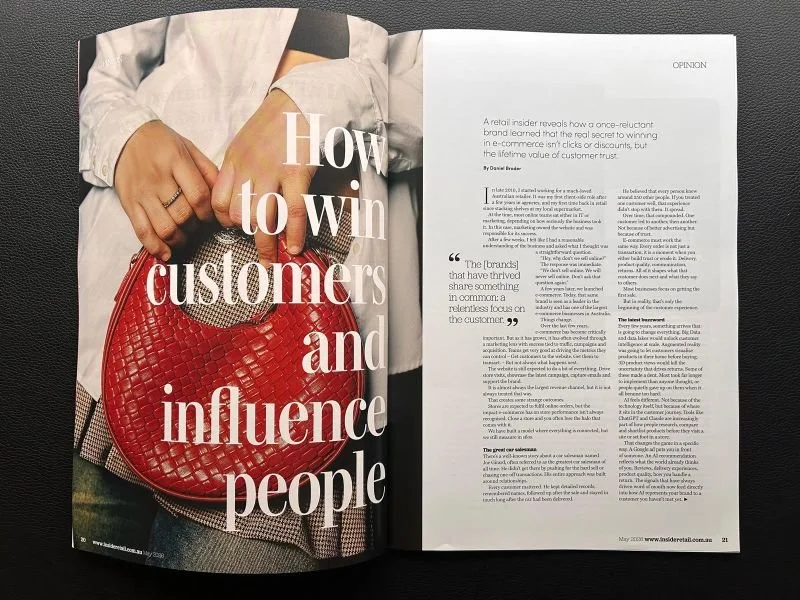
How to win customers and influence people
Why do some retailers keep winning while others slowly lose relevance? In this piece first published in Inside Retail, we explore how ecommerce became overly focused on traffic and acquisition, while the retailers building long-term success are obsessing over what happens after the sale. From customer experience and loyalty to AI-driven discovery and lifetime value, this is a practical look at why trust, service and consistency now matter more than ever.
In late 2010, I started working for a much loved Australian retailer. It was my first client-side role after a few years in agencies, and my first time back in retail since stacking shelves at my local supermarket.
At the time, most “online” teams sat either in IT or Marketing, depending on how seriously the business took it. In this case, marketing owned the website and was responsible for its success.
After a few weeks, I felt like I had a reasonable understanding of the business and asked what I thought was a straight forward question.
“Hey, why don’t we sell online?”
The response was immediate.
“We don’t sell online. We will never sell online. Don’t ask that question again.”
A few years later, we launched ecommerce. Today, that same brand is seen as a leader in the industry and has one of the largest ecommerce businesses in Australia.
Things change.
Over the last few years, ecommerce has become critically important. But as it has grown, it has often evolved through a marketing lens with success tied to traffic, campaigns and acquisition. Teams get very good at driving the metrics they can control.
Get customers to the website. Get them to transact.
But not always what happens next.
The website is still expected to do a bit of everything. Drive store visits, showcase the latest campaign, capture emails, support the brand.
It is almost always the largest revenue channel, but it is not always treated that way.
That creates some strange outcomes.
Stores are expected to fulfil online orders, but the impact ecommerce has on store performance isn’t always recognised. Close a store and you often lose the halo that comes with it.
We have built a model where everything is connected, but we still measure in silos.
The Greatest Car Salesman
There’s a well-known story about a car salesman named Joe Girard, often referred to as the greatest car salesman of all time.
He didn’t get there by pushing for the hard sell or chasing one-off transactions. His entire approach was built around relationships.
Every customer mattered. He kept detailed records, remembered names, followed up after the sale and stayed in touch long after the car had been delivered.
He believed that every person knew around 250 other people. If you treated one customer well, that experience didn’t stop with them. It spread.
Over time, that compounded. One customer led to another, then another. Not because of better advertising but because of trust.
Ecommerce must work the same way.
Every order is not just a transaction, it is a moment where you either build trust or erode it. Delivery, product quality, communication, returns. All of it shapes what that customer does next and what they say to others.
Most businesses focus on getting the first sale.
But in reality, that’s when the customer experience really begins.
The latest buzzword
Every few years, something arrives that is going to change everything. Big Data and data lakes would unlock customer intelligence at scale. Augmented reality was going to let customers visualise products in their home before buying. 3D product views would kill the uncertainty that drives returns. Some of these made a dent. Most took far longer to implement than anyone thought, or they quietly gave up when it all became too hard.
AI feels different. Not because of the technology itself, but because of where it sits in the customer journey. Tools like ChatGPT and Claude are increasingly part of how people research, compare and shortlist products before they visit a site or set foot in a store.
That changes the game in a specific way. A Google ad puts you in front of someone. An AI recommendation reflects what the world already thinks of you. Reviews, delivery experiences, product quality, how you handle a return. The signals that have always driven word of mouth now feed directly into how AI represents your brand to a customer you haven't met yet.
There is nowhere to hide. A pattern of poor delivery, inconsistent product quality or a frustrating returns process used to be manageable. You could outspend it or at least contain it. Now those signals are aggregated, surfaced and handed to your next potential customer before they've even clicked on your site.
Revenue from AI-driven traffic is still small. But the direction is only going up and the businesses that show up well in that environment are the ones doing the unsexy work now. Not on campaigns, but on the experience that happens after someone clicks buy.
There can be only one
Traffic and conversions matter. Anyone who tells you otherwise hasn't run an ecommerce business. But if you had to choose one metric, one number that forces the right decisions across pricing, experience, product and marketing, it has to be lifetime value.
LTV changes what you focus on. When the goal is a returning customer rather than a single transaction, the priorities shift in ways that compound over time. Delivery stops being an operational footnote and becomes a brand decision. Product quality stops being a cost-of-returns problem and becomes the foundation everything else is built on.
Customer experience stops being a nice to have and becomes the thing that either brings someone back or doesn't.
Real loyalty follows the same logic. Most loyalty programs are built around the transaction, rewarding behaviour that would have happened anyway and training customers to wait for the next discount. That's not loyalty, it's conditioning. When LTV is the measure, you stop asking "how do we get them to buy again" and start asking "why would they choose us again." The answer is rarely points. It's usually reliability, service and a brand I can trust.
It also changes how you think about price. Competing on price alone is a race you won't win. Amazon, Shein and Temu will always be cheaper. The margin erosion required to keep up will slowly destroy your business. But when LTV is the lens, you're not trying to win on price alone. You're giving customers a reason to come back that has nothing to do with a discount code. That's harder to build and harder to copy.
I briefly worked for a startup in the food delivery space. One day, the owner came in and the first words out of his mouth where "Why have we only had 1,000 sessions today?"
So, what did we do to address that. Discounts, campaigns driving sales but the underlying business wasn’t improving and profits were rapidly disappearing. If the question had been around building lifetime value, the strategy would have looked completely different.
This is how to win
The last few years have not been kind to retailers. Lockdowns, rising costs, margin pressure and a wave of global competitors have tested even the most established brands. Some didn't make it. Brands that Australians had shopped for decades disappeared overnight.
The ones that have thrived share something in common. A relentless focus on the customer. They know that getting the sale is only the first step. It's what you do next that matters most. Not because it's a nice idea, but because in a market this competitive, it's the only strategy that lasts.
This article was first published in the Inside Retail Australia May 2026 Edition
The Ecommerce Tech Stack Explained: What Retailers Need and When
Retail ecommerce runs on many connected systems. Platforms, payments, inventory, marketing tools and analytics all need to work together. Understanding the ecommerce tech stack helps retailers see how these systems fit together and how the stack typically grows as a business scales online.
Every retail business reaches a point where the tools it's using to run stop keeping up with how it actually operates.
Sometimes that's about size. More often it's something more specific. You've got more SKUs than a spreadsheet can handle. You're fulfilling from multiple warehouses instead of one. Order volumes have grown to the point where doing things manually starts causing mistakes. You've added wholesale on top of your DTC channel. You've brought in a 3PL. You've started selling on marketplaces like Amazon or eBay and now product data, inventory and orders are coming in from five different places at once.
Each of those changes puts pressure on a different part of your ecommerce tech stack. And the tool that handled it fine six months ago quietly becomes the thing holding you back.
The ecommerce tech stack is the collection of software systems a retail business uses to run its online operations. It covers everything from the storefront customers see, to the order management, inventory, fulfilment, customer data and payments infrastructure running behind it. Most retailers don't build it deliberately. It grows alongside the business, one tool at a time.
The problem usually isn't that retailers have the wrong technology. It's that the technology hasn't kept up with how the business has changed. You add something to fill a gap. Then something else. Workarounds stack up. And at some point nobody's quite sure what's running, what's doing the same job twice, or where the problems are actually coming from.
This is a guide to the ecommerce tech stack: the layers it's built from, what sits inside each one and the signs that tell you when what you've got isn't cutting it anymore.
The stack has layers. Each one does a different job.
The ecommerce tech stack isn't one system. It's a set of platforms, each solving a specific problem at a specific layer of the business.
Most complexity comes from not knowing which layer a problem belongs to. You buy the wrong solution, or you buy the right one before you actually need it.
The layers, from what your customer sees through to the back office:
Experience - what your customer sees
The experience layer is your storefront: the ecommerce platform, website and CMS your customers interact with directly. Shopify, BigCommerce and Commercetools are common platforms here. This is usually the first investment a retail business makes and the one with the most direct impact on conversion and revenue.
At the enterprise end, a Digital Experience Platform (DXP) combines content management, commerce and personalisation in a single layer.
Most businesses don't need that until they're operating across multiple brands, regions, or channels and the complexity of managing them separately becomes a real problem.
Marketing - acquisition and retention
The marketing layer is how you acquire customers and bring them back. It includes your Email Service Provider (ESP) for campaigns and automation, your Marketing Automation Platform (MAP) for multi-channel customer journeys and your analytics tools for understanding what's working.
Klaviyo, Attentive, Dotdigital and Mailchimp are common tools here. Most retailers add email early and then upgrade to a more comprehensive platform as volume and complexity grow.
Commerce - the mechanics of buying and selling
The commerce layer covers the systems that sit between your storefront and your back office. That includes your Product Information Management system (PIM) for managing product data, your Order Management System (OMS) for handling orders from checkout through to delivery and any subscriptions or Buy Now Pay Later (BNPL) infrastructure.
For smaller retailers, the ecommerce platform handles most of this natively. As SKU count grows, channels multiply and order volumes increase, dedicated systems start to earn their place.
Data - customer intelligence
The data layer is your customer intelligence infrastructure. A CRM (Customer Relationship Management system) manages customer relationships and interactions. A CDP (Customer Data Platform) unifies customer data from every touchpoint into a single profile. A data warehouse stores the broader analytical picture.
Operations - the back office
The operations layer is everything that keeps the business running behind the scenes. An ERP (Enterprise Resource Planning system) manages finance, inventory, HR and procurement. A WMS (Warehouse Management System) controls warehouse operations. 3PL integrations connect your stack to outsourced fulfilment partners.
Retailers often outgrow the tools in this layer before they realise it. The signs show up in the data, in missed SLAs, in inventory discrepancies, before they're felt as a business problem.
Payments - how money moves
The payments layer covers how transactions are processed and settled. A PSP (Payment Service Provider) like Stripe or Adyen handles the end-to-end payment process: authorisation, settlement and the merchant account. PCI DSS is the compliance framework that governs how card data is handled and using a reputable PSP covers most of that obligation.
BNPL providers like Klarna and Afterpay sit in this layer too, added at checkout when order value and conversion data support it.
Infrastructure - the connective tissue
The infrastructure layer is what connects everything else. APIs allow different systems to share data. A CDN (Content Delivery Network) keeps your site fast by serving assets from servers close to the user. Integration platforms automate data flows between systems. Authentication tools keep everything secure.
This layer is invisible when it works. It becomes a serious focus as the number of connected systems grows and the cost of things not talking to each other properly starts showing up in the business.
How the stack changes as a retail business grows
The most consistent mistake is adding enterprise-level systems before the business needs them. The cost isn't just the software licence. It's the implementation time, the internal resource required to run it and the distraction from problems that actually matter right now.
The right question isn't "what does a business our size use?" It's "what problem are we actually trying to solve and is the complexity of this system justified by the problem it fixes?"
Early stage
At the start, the stack is simple and that's fine. An ecommerce platform, analytics and an email marketing platform covers most of what's needed. The platform handles orders natively, a spreadsheet may be used to manage inventory and accounting software handles the finances.
The priority here is understanding what's working, not building infrastructure for a scale that hasn't arrived yet.
When complexity starts to show
The gaps usually appear before the revenue numbers suggest they should. SKU count creeps up and product data management becomes messy. A second fulfilment location gets added and order routing becomes manual. Marketplace selling begins and inventory sync becomes a daily headache.
This is when dedicated tools start to earn their place. A CRM when customer relationships are too valuable to manage in a spreadsheet. An OMS when order routing has enough variables that getting it wrong has a real cost. A more capable ESP or MAP when basic email automation isn't enough anymore.
When the stack becomes a constraint
At some point the tools that got a business to where it is start to limit where it can go. Finance and inventory can't be reconciled across three different systems. Customer data lives in five places and none of them agree. The warehouse is running on a process that works until it doesn't.
This is when an ERP starts to make sense: when the business needs a single source of truth for operations and finance. When a PIM becomes necessary: when product data complexity has outgrown any manual process. When a CDP becomes justified: when customer data is fragmented enough that fixing it is a genuine strategic priority.
Enterprise scale
At enterprise scale the stack is a strategic asset and the decisions around it carry real commercial weight. The question shifts from what do we need to how do we make what we have work better together and where are the integrations creating risk.
Composable architecture - often referred to as MACH (Microservices, API-first, Cloud-native, Headless) - becomes relevant when a business has outgrown its monolithic platform and needs the flexibility to swap components without rebuilding everything. Enterprise-grade versions of CRM, OMS, ERP and CDP replace the mid-market tools that got the business here.
The stack serves the business. Not the other way around.
Ecommerce complexity builds quietly. A system gets added to solve one problem and creates an integration challenge. That challenge gets patched. The patch creates a dependency. And eventually nobody has a clear picture of how it all fits together.
Understanding the layers of the ecommerce tech stack and which system belongs at which layer, is the starting point for cutting through it.
The right stack for a retailer with a single warehouse, one channel and 200 SKUs looks nothing like the right stack for one with three warehouses, marketplace presence, a wholesale arm and 5,000 SKUs. That's not a problem. That's how it's supposed to work.
Need helping figuring out what’s right for your business? Let’s Talk